Showing posts with label petals. Show all posts

Sunday, 18 December 2011

Photobucket

The thing I like most about this charming and very very orange flower, is it's scrunched up curly-wurly petal. The thing I like least is my photography skills. WHY GOD WHY did I have to cut half the petals out of the shot? It looks very ungainly. Originally this was not going on the blog for that precise reason, but I'm so low on picture stocks right now that I'm scraping the bottom of the barrel. Or possibly bouquet.

Oh well. Into each life some rain must fall.

So I've been racking my brains to think of something interesting to discuss in this post but unfortunately I have realised that I'm not very good at it. I have lots of interesting thoughts whilst wandering around the place, but few when sat at the computer. What I need is a dictaphone. Then I can be one of those people who strides around the place grasping a small black box to my face and shouting "NOTE TO SELF: TURN OVEN OFF" and "MUST BUY BINBAGS".

Ooh, binbags!

"What a dull topic!", I hear you cry. "There is nothing exciting about binbags!"

That is where you are wrong. Did you know that the binbag was invented by Herbert A. Resplendency-Potts of Wiltshire in 1894, after a careless servant dropped a lead dustbin on his foot? Of course you don't, because it's a huge lie. In fact, they were invented in the 1950s by three Canadians, who to the best of my knowledge had suffered no garbage-related trauma. But it's not such a good story.

Also exciting are the novelty Christmas pudding binbags which I recently came across in John lewis. I was extremely excited ...until I realised that I don't take out the rubbish. But one day, when I have my own house, my rubbish will out-Christmas everyone else's. Plus, even when it's not Christmas you can get these novelty goldfish binbags. Your neighbours probably won't judge you at all.

Saturday, 3 December 2011

Pastel Perfect

Photobucket

I was surprised to see that I hadn't already blogged this picture, because I am quite fond of it! I love the colours of the hydrangea and the contrast with the little marmalade hoverfly (which looks like it's balancing on one leg in that picture).

Whilst I don't know the name of this kind of hydrangea (I would guess it's hydrangea macrophylla?), it's apparently a lacecap as opposed to a mophead - meaning that it has large, showy but sterile flowers around the outer edge of a number of much smaller fertile ones -you can see the two types in the picture. Mophead hydrangeas are the ones you immediately think of when someone leaps out from behind a wall and shouts "hydrangea!" - i.e., the ones with big round fluffy-looking flowerheads. The colour of your hydrangeas will be affected by the pH of the soil, which is rather interesting.

Thursday, 1 December 2011

Foxglove

Photobucket

This is a foxglove. I believe it is the Common Foxglove, digitalis purpurea (which sounds like some kind of hideous rash you might get on your hands.. but no matter). It's an interesting name and one apparently widely open to debate, but according to some 19th Century book of botany quoted on Wikipedia: "In south of Scotland it is called 'bloody fingers', more northward, 'deadman's bells'", which seem like unnecessarily gruesome names for what is quite a pretty plant. Probably this comes from the fact that it's extremely poisonous, as the leaves, flowers and seeds all contain digitoxin. Digitoxin has been used as a treatment for heart failure, as pioneered by William Withering (fabulous name for a botanist).

Withering also recommended it for the treatment of dropsy, a hilarious-sounding old fashioned disease which, I've just discovered, was an archaic name for oedema (Edema, if you're American. Or just can't spell). I always feel faintly guilty when I find the names for medical conditions funny. Like botulism. I don't know why, but the name just amuses me, whereas I suspect the actual condition itself would very definitely not...

Tuesday, 29 November 2011

High Drama

Photobucket

A rather lovely and highly melodramatic rose, still covered in raindrops after a brief shower. I always find it tricky to get nice pictures of roses, and this took an awful lot of attempts, but I'm fairly pleased with how it came out! Worthy of a tragic romance...

Tuesday, 15 November 2011

Purple Zebra

Photobucket

A zebra-striped iris. Apparently irises get their name from the Greek word for 'rainbow', because they come in so many different colours. Without much hope of success, I typed the words "purple iris" into Google to attempt to identify this fine specimen, and sure enough I completely failed at my task. But I'm pretty sure it's an iris of some description! What more do you need?

Wednesday, 26 October 2011

A Brief History of Thyme

Photobucket


In Ancient Egypt, thyme was used in the embalming process; in ancient Greece, it was used as incense and believed to be a source of courage; the Romans spread the herb across Europe through their use of it to purify their rooms and flavour certain foods; in the Middle Ages it was used to ward off nightmares and promote a good night's sleep.

Okay, I'm done now. Thanks again, Wikipedia!

Obviously the above photograph is not of a thyme plant, it's some kind of very pretty iris, one of my favourite kinds of flower.

Saturday, 22 October 2011

Give Me Your Answer, Do

Photobucket

Taken on a cliff-top walk in Cornwall. It was a really lovely walk, although unfortunately like an idiot I managed to get a fairly horrific sunburn on the back of my legs and spent the next few days slathering them in
olive oil and E45 moisturiser. Also, because we were camping, every time I had to crawl into the tent, the backs of my knees registered serious complaints with my brain. It was painful! So don't do that.

Interestingly, I was reading recently that the song "Daisy Daisy" (you know the one… about a bicycle made for two), was apparently first written about Daisy Greville, Countess of Warwick and mistress of Edward VII. Apparently she was known as the "Babbling Brooke" for her inability to keep things discreet and was thought to be partially responsible for the leaking of the Royal Baccarat Scandal in 1890, which resulted in Edward being called to testify in court and the whole affair turned into a bit of a society spectacle. It's strangely comforting to know that even a hundred years ago, tabloid gossip was still tabloid gossip.

I also like how the Wikipedia article on the scandal states that Prince Edward restrained his gambling afterwards, by taking up whist instead of baccarat. An altogether more respectable card game. And, incidentally, one which I learned how to play whilst on holiday in Cornwall. So the cycle of facts turns full circle.

Friday, 14 October 2011

Petals

Photobucket

This is one of my absolute favourite photos. And one of my less original post titles, oops. The disadvantage of the way I post pictures on this blog is that they're all teeny so you don't get to appreciate the clarity of the photo at full resolution. I originally intended to put them all up on flickr and then cross post them here, but a) it seemed like effort and b) I managed to lock myself out of my flickr account (genius, I know).

I am considering adding some of the photos to posts at full size under a cut, if I can work out how to do it, and this is a prime candidate! No clue what kind of flower it is, though. A pink one?

I did consider using it as my desktop background, but it would mean ousting two very charming narwhals, to whom I am very attached. Did you know that the narwhal's tusk is actually a tooth which grows right through the top lip of the male narwhals? Some of them even have two.

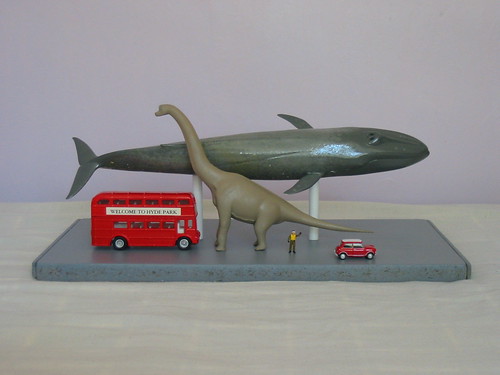
National Geographic's website does the classic "size of whale compared to a bus" analogy on all its whale pages (a humpback is the size of one large bus; a blue whale about three buses; a narwhal less than one bus). Why is it that whales are always compared to buses? It seems strange that "a bus" has become an informal unit of measurement for sea mammals.(And dinosaurs). How did this begin? Why the relentless association with buses? Why not a train? or a tank? or a herb garden? Has anyone found the first instance in which a whale was compared in size to a bus? And how does it work across national boundaries? A London double-decker bus seems to be the standard measurement in the UK, but judging by the pictures on Nat Geo's website, they're using an American yellow school bus. These buses are different sizes. Is this accounted for in the comparison? Will we ever know?

Monday, 10 October 2011

On The Cusp

Photobucket

I love orange! As, presumably, does this marmalade fly, episyrphus balteatus. They're super common and live all over the place. Strangely I've never been a big fan of marmalade, despite my passion for all things orangey - it's much too bitter. Apparently the whole reason it's so bitter is that English marmalade uses Seville oranges for their high pectin content, which enables the preserve to set well - California marmalade uses sweet oranges (and is therefore probably much nicer).

Wikipedia tells us that in 1524, Henry VIII received a box of marmalade from a Mr Hull of Exeter, allthough quite why is unclear. Apparently it was originally made from quinces and imported into Britain in wooden boxes rather than jars, and it wasn't until the 1700s that it started to be eaten as an accompaniment rather than just as a sweetmeat in its own right.

I remember as a child I had high expectations regarding the deliciousness of marmalade, thanks to the charming Paddington Bear, who had such a serious addiction to the stuff that, were he human, questions would have been asked regarding his suitability as a role model for small children. As far as I was concerned at the time, however, if a cartoon bear liked it, then it must be pretty delicious. You can imagine my disappointment when I actually tried it.

Friday, 30 September 2011

The Classic

Photobucket

Aaaand it's a brief return to form with one of my favourite orange flower pictures.

This was taken at Buckfast Abbey. It's the home of a group of practising Benedictine monks, who are very devout and incidentally brew a highly caffeinated tonic wine famed as the scourge of Scotland and mentioned in over 5,000 crime reports in Strathclyde between 2006-9.

We only saw one monk while we were there, though, and as he was sitting on a wall with his head in his hands looking incredibly depressed I decided not to accost him and ask him about it. We did buy some wine, though, and took it home to try later. It tasted like alcoholic cough medicine.

On the plus side, as well as encouraging alcoholism in the distant north, the monks have some nice grounds including an interesting herb garden with plants segregated by use; medicinal, household, kitchen, and poison (amusingly, the poisonous plants were kept away from wayward hands by means of a small moat).

Monday, 26 September 2011

Cyclamen

Photobucket

These are cyclamen, and very nice they are too. I like their little wiggly stalks, they're like pig's tails. And they grow out of a corm, which is an excellent word.

Another excellent word I discovered recently is globster: an unidentified mass of organic matter washed up on a shoreline, and the source of many a sea monster myth. Apparently decomposing basking sharks strongly resemble plesiosaurs. Who knew?

Incidentally, Wikipedia has a page entitled "exploding whales". And believe me when I say it's a blast.

Friday, 16 September 2011

Dappled Light

Photobucket

A return to my traditional "yay! flowers" approach to photography - although as I recently proved, I am trying to break the cycle of addiction. This is some kind of rose, which was boldly protruding from a stranger's garden fence. If this were the olden days, perhaps I would have picked it and stolen it away with me, leaving them with a sadly denuded floral display. Fortunately, however, the power of the digital camera means I didn't have to.

We also discovered some very cool African Geese. Sadly all the photos I took of them were rubbish, but when I tried to find a better one on Google, it seems that all the other photos out there are even worse. Consequently I may, somewhat shamefacedly, put up the rubbish pictures, just because I want to convey how awesome these geese are. They have strange knobbly heads and one of them (I'm guessing the male) had a huge dewlap which wobbled disconcertingly as he walked around.

Saturday, 10 September 2011

Brightness

Photobucket
After all those drab rainy pictures, it's back to chirpy flowers! Although for how much longer, I can't say. I'm afraid my large backlog of photos is already starting to run low after only a month or two of blogging... eek. Hopefully this will provide the impetus required to go out and take lots more lovely pictures and not the impetus require to go "ah well, nevermind" and completely abandon this blog. That would be sad. But it's definitely trickier to enjoy photography in the winter. For one thing, the light's not as good; the flowers have all disappeared and (horror of horrors) sometimes it's pretty damp and chilly to be standing around taking forty pictures of the same tree to get it just right. And I refuse to post pictures which I don't actually like!

So I guess I better take advantage of whatever sunshine sees fit to grace our shores this September, and get snapping...

Incidentally in Ghana I noticed that they use the word "snap" in the same way we use the word "photo"; a photo is a snap, while to take a photo is to snap. I thought it was a cute usage of the word (although briefly confusing when people ask if you want to snap them...)

Saturday, 27 August 2011

Sunshine After The Rain

Photobucket
I went on a trip to the local Botanical Gardens with my mother one day and we had the most peculiar weather. All in all it rained - heavily - on four separate occassions, but always at a relatively convenient moment; on our first trip to the tea rooms for lunch (delicious soup... tomato and chorizo, I believe, which I loved), then when we were standing right by the large greenhouses, then twice when we were back at the tea rooms, enjoying another couple of well-earned cups of tea. These gorgeous flowers (my mum told me their name and I promptly forgot. She would be very disappointed in me) grew all around the greenhouses, and when the sun suddenly emerged from behind the clouds, like an increasingly confident streaker at a public sports match, they looked fantastic, all damp and fresh from the rain.

Friday, 19 August 2011

Crumpled Glory

Photobucket
I adored these flowers. They're absolutely huge, with great blousy petals; even just looking at the picture, they're such a wonderful texture that I just want to reach out and touch them.

Wednesday, 17 August 2011

Transparent Rose

Photobucket
This photo shows how transparent individual petals can be, but all together they build up into a really rich, thick colour.

Thursday, 11 August 2011

Stripes

Photobucket
I'm still annoyed at myself for having sliced off the edges of the petals in this picture. I was in a hurry, we were just about to leave the garden when I suddenly saw these flowers and they really struck me. The combination of very vibrant, unusual colours with a rather standard and unexciting shape is refreshing.

Tuesday, 9 August 2011

Sunshine Flower

Photobucket
Despite yesterday's outpouring of a single interesting fact, I'm back to wallowing in my own ignorance with today's flower. The photo was taken on a recent visit to Cornwall, where we visited several gardens, all of them absolutely gorgeous. My favourite was Trebah Gardens, which not only boasts its own private beach, but also has a bamboo maze, a shady secret passage beneath the giant leaves of huge gunnera plants (also known as "Elephant's Rhubarb") and (my new favourite word), a stumpery. Yes, even their collection of tree stumps is awesome.

Monday, 8 August 2011

Raspberry Ripple Flower, and a Fact of the Day

Photobucket
The pattern of these petals is stunning and reminds me of an interesting thing, which I hereby present to you as my Fact Of The Day: some flowers have markings on their petals which we can't see, because they reflect UV light that our eyes don't pick up. Certain pollinating insects can see into different spectral bands than humans, and the flowers' colouring reflects this; sometimes what appears to us as a fairy unexciting bloom looks quite different if you use a camera which is able to record ultra violet or infra red light. There's a really nice website here which has photos of different flowers shown as they normally appear to us, and coloured to show the UV patterns and fluorescence which we can't see. Some of my favourite examples include this picture, which I think is featured in Richard Dawkins' book The Greatest Show On Earth, this very jazzy example, and this rather dramatic bloom, which clearly shows the "bulls-eye" pattern that a lot of UV-patterned flowers exhibit.
So next time you see a rather plain and insipid bouquet, just remember: perhaps it's your eyes and not the flowers which are at fault...