 |
| A Bactrian Camel at London Zoo |
Showing posts with label animals. Show all posts
Showing posts with label animals. Show all posts
Thursday, 15 March 2012
Alice The Camel


Tuesday, 13 March 2012
Hay There

It's a photograph of a giraffe eating hay. Hurrah! The giraffes at London Zoo were a little sad when we saw them, because they weren't able to go outside as the ground was just covered in ice. I've never seen a giraffe slip over, but I imagine it's not something to be desired.
Sunday, 11 March 2012
Simba...
 |
| Asian lion cub at London Zoo |
Asian lions are super endangered. Although they used to have a range that continued as far west as Greece and Italy, these days they are only found in the wild in the Gir forest of Gujarat, India; a census of the lion population in 2011 indicated that there were about 411 Asiatic lions in the world, up from a total of 234 in 1936 when the first ever census was taken. They are threatened by habitat destruction, and are killed by electric fences and open wells.
Friday, 9 March 2012
Flutter By
 |
| Butterfly in London Zoo's Butterfly Paradise |
While we were in the butterfly house, my boyfriend told me that some butterflies drink blood. Thinking he had gone briefly mad, I laughed and said he was confusing them with bats. But no! I was entirely wrong. It was there in black-and-white on one of the signs in the exibit. I googled it, and found this picture of butterflies drinking blood from a sock. Yes, you heard me. A sock. If you didn't know already, it turns out that butterflies are one of the sock's few natural predators. Also, here is a National Geographic article about vampire moths. Apparently in Slavic folklore, vampires were able to take the form of butterflies.

This whole discovery has rather changed the way I view these insects. I used to think they were nice decorative creatures to have around the place, sort of like nature's bunting. Now I know they are opportunistic greedy blood-sucking horrors. The butterfly house will never be the same again.
Wednesday, 7 March 2012
Tell Me A Tail
 |
| Squirrel Monkeys at London Zoo |
And what did she do? Tried to touch a monkey. Oi vey.
Monday, 5 March 2012
High Speed Sloth
 |
| Linnaeus's Two-toed Sloth |
Sloths are amazing because they're the only living mammal that looks more realistic in CGI than in real life. The way they move is so laboured, it's like every moment they're wondering if they really want to get to where they're going at all. That or they're stop-motion animated.
It's not a particularly exciting photograph, and it wasn't helped by the fact that the rainforest building's accurate recreation of a rainforest environment steamed up both my glasses and my camera. But who cares. Sloths are cool.
Thursday, 1 March 2012
Peck
 |
| Juvenile penguin at London Zoo's Penguin Beach |
Tuesday, 28 February 2012
Furball
 |
| Photograph of a prarie dog at London Zoo |
And the keeper was most rude when I complained about it. Really, you'd think they'd train the animals to be more photogenic.
FUN FACTS ABOUT PRARIE DOGS:
1. Prarie dogs are rodents, not dogs, as I was surprised to learn aged eleven, having assumed they were America's equivalent of the dingo.*
2. According to Professor Con Slobodchikoff, prarie dogs may have the most sophisticated language of any animal, able to communicate the news of predators approaching as well as describing the colour, type of predator, and the direction it's coming from.
3. Prarie dogs are social creatures and are very affectionate, greeting one another with a prarie dog kiss.
4. Black-tailed prarie dogs live in large communities known as "towns". The largest known prarie dog town covered 25,00 square miles in Texas and was home to perhaps as many as four hundred million prarie dogs.
Who knew?
_________________________________________________________
*Without the baby eating.
Friday, 24 February 2012
Hey Hey We're The Monkeys
 |
| Two squirrel monkeys |
The most famous squirrel monkey of them all was of course Miss Baker, one of the first two animals who were launched into space in 1959 and survived, along with the rhesus monkey Miss Able. She went on to live for twenty five years afterwards, receiving copious amounts of fanmail from children who'd heard of her exploits, and when she died of kidney failure in 1984, over 300 people attended her funeral.

Who knew!
Monday, 20 February 2012
Funny Looking Penguin
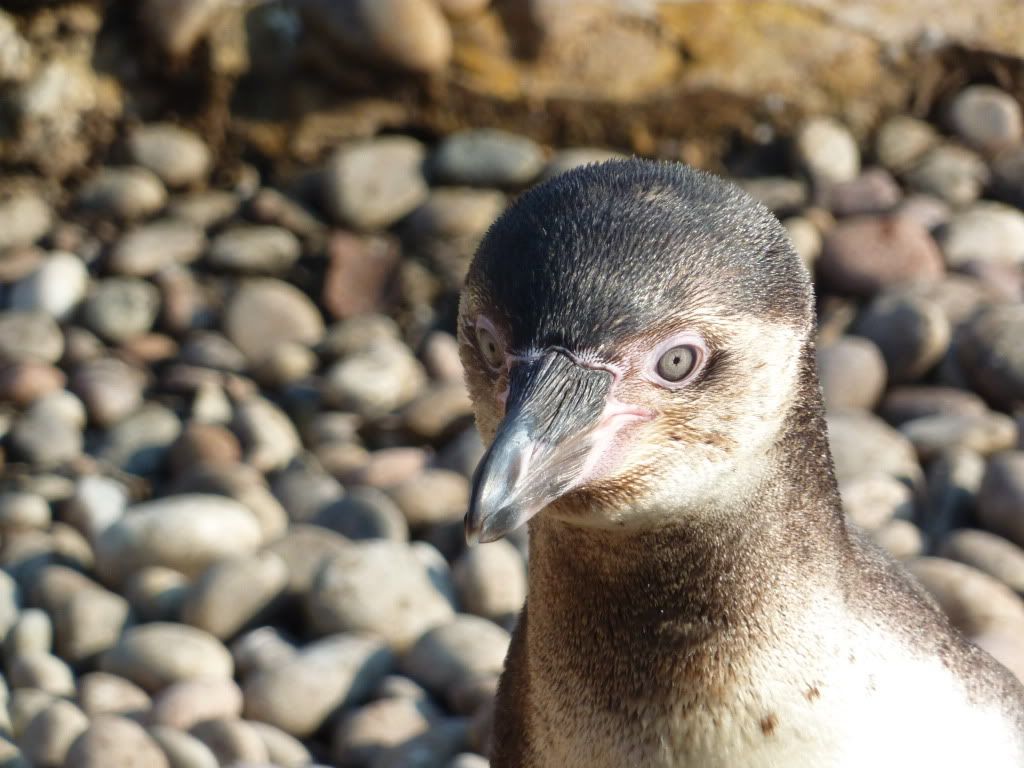 |
| Juvenile Penguin at London Zoo |
So on balance, I suspect this photograph is of a juvenile humboldt or blackfooted penguin, but who knows which! It's tricky to judge before their adult feathers come in. Alas, I obviously make a poor ornithologist. Ho hum! He was an obligingly photogenic fellow, whatever he is, unlike all his friends who were waddling and splashing and zooming around the pool with no thought for the humans vainly trying to get a good shot of them.
Saturday, 18 February 2012
Squirrel Monkey
 |
| Common Squirrel Monkey |
The Common Squirrel Monkey comes from the Amazon Basin in South America, and lives in the middle canopy of the rainforest. At first, when I saw the monkey in this photo carefully examining and later nibbling his tail I wondered what he was doing, but apparently squirrel monkeys have a habit of smearing food onto their tails, and may smear urine all over themselves as well. A charming habit! I suspect that advertising that particular fact in the squirrel monkey enclosure would actually be more effective at persuading people not to try to touch the monkeys than all the signs warning that they bite.
An interesting fact about squirrel monkeys relates to their colour vision; in these monkeys, one gene on the X chromosome codes for colour vision, and there are three versions of this gene, each of which produces a pigment sensitive to a different wavelength of light. Because male squirrel monkeys have only one X chromosome, they are dichromatic (i.e. any colour which they can see can be created using a mixture of just two pure spectral lights - similar to what we call colour blindness in humans); however, because female squirrel monkeys have two X chromosomes, about two-thirds of them have trichromatic vision like humans (i.e. a mixture of three pure spectral lights is required to create all the colours which they are able to see). Researchers have successfully used gene therapy to give adult male squirrel monkeys trichromatic colour vision.
Subscribe to:
Posts (Atom)