Showing posts with label pink. Show all posts

Saturday, 3 December 2011

Pastel Perfect

Photobucket

I was surprised to see that I hadn't already blogged this picture, because I am quite fond of it! I love the colours of the hydrangea and the contrast with the little marmalade hoverfly (which looks like it's balancing on one leg in that picture).

Whilst I don't know the name of this kind of hydrangea (I would guess it's hydrangea macrophylla?), it's apparently a lacecap as opposed to a mophead - meaning that it has large, showy but sterile flowers around the outer edge of a number of much smaller fertile ones -you can see the two types in the picture. Mophead hydrangeas are the ones you immediately think of when someone leaps out from behind a wall and shouts "hydrangea!" - i.e., the ones with big round fluffy-looking flowerheads. The colour of your hydrangeas will be affected by the pH of the soil, which is rather interesting.

Thursday, 1 December 2011

Foxglove

Photobucket

This is a foxglove. I believe it is the Common Foxglove, digitalis purpurea (which sounds like some kind of hideous rash you might get on your hands.. but no matter). It's an interesting name and one apparently widely open to debate, but according to some 19th Century book of botany quoted on Wikipedia: "In south of Scotland it is called 'bloody fingers', more northward, 'deadman's bells'", which seem like unnecessarily gruesome names for what is quite a pretty plant. Probably this comes from the fact that it's extremely poisonous, as the leaves, flowers and seeds all contain digitoxin. Digitoxin has been used as a treatment for heart failure, as pioneered by William Withering (fabulous name for a botanist).

Withering also recommended it for the treatment of dropsy, a hilarious-sounding old fashioned disease which, I've just discovered, was an archaic name for oedema (Edema, if you're American. Or just can't spell). I always feel faintly guilty when I find the names for medical conditions funny. Like botulism. I don't know why, but the name just amuses me, whereas I suspect the actual condition itself would very definitely not...

Wednesday, 9 November 2011

Freaky Stuff

Photobucket</>

Close-up of the stem of a giant gunnera plant, gunnera manicata. Them's some peculiar plants, it's got to be said!

Friday, 14 October 2011

Petals

Photobucket

This is one of my absolute favourite photos. And one of my less original post titles, oops. The disadvantage of the way I post pictures on this blog is that they're all teeny so you don't get to appreciate the clarity of the photo at full resolution. I originally intended to put them all up on flickr and then cross post them here, but a) it seemed like effort and b) I managed to lock myself out of my flickr account (genius, I know).

I am considering adding some of the photos to posts at full size under a cut, if I can work out how to do it, and this is a prime candidate! No clue what kind of flower it is, though. A pink one?

I did consider using it as my desktop background, but it would mean ousting two very charming narwhals, to whom I am very attached. Did you know that the narwhal's tusk is actually a tooth which grows right through the top lip of the male narwhals? Some of them even have two.

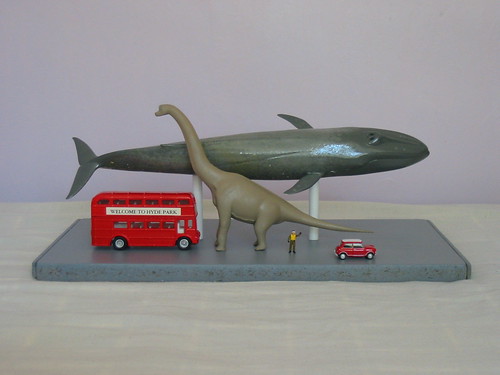
National Geographic's website does the classic "size of whale compared to a bus" analogy on all its whale pages (a humpback is the size of one large bus; a blue whale about three buses; a narwhal less than one bus). Why is it that whales are always compared to buses? It seems strange that "a bus" has become an informal unit of measurement for sea mammals.(And dinosaurs). How did this begin? Why the relentless association with buses? Why not a train? or a tank? or a herb garden? Has anyone found the first instance in which a whale was compared in size to a bus? And how does it work across national boundaries? A London double-decker bus seems to be the standard measurement in the UK, but judging by the pictures on Nat Geo's website, they're using an American yellow school bus. These buses are different sizes. Is this accounted for in the comparison? Will we ever know?

Monday, 26 September 2011

Cyclamen

Photobucket

These are cyclamen, and very nice they are too. I like their little wiggly stalks, they're like pig's tails. And they grow out of a corm, which is an excellent word.

Another excellent word I discovered recently is globster: an unidentified mass of organic matter washed up on a shoreline, and the source of many a sea monster myth. Apparently decomposing basking sharks strongly resemble plesiosaurs. Who knew?

Incidentally, Wikipedia has a page entitled "exploding whales". And believe me when I say it's a blast.

Thursday, 22 September 2011

Grapes!

Photobucket

A couple of weeks ago, as I was leaving the house, I heard the sound of someone singing a song - apparently a song entitled "everyone loves grapes". I deduced that this was the title because these were the only words.

I walked my usual route and quickly noticed that a stick was protruding from the high fence around the house at the end of the road. From the stick hung a piece of string, and a small bunch of grapes was tied to the string so they dangled at about head height for anyone walking by. Two children were sitting at the top of the fence and appeared to be the grape-stewards.

"Do you want a grape?" the small girl cried jubilantly as I approached.
"Er, no thank you," I said. "But it's very kind of you to ask."
"Grapes!" she said. "Grapes!"
"Grapes!" cried her brother. And they resumed singing.

***

When I returned from work at the end of the day, the empty grapestalk was hanging forlornly at the end of its string next to a hand-written sign that said "Grapes! Help yourselves!"

Thursday, 18 August 2011

Pink Wednesday

Photobucket
When I was at school, my group of friends had a tradition of naming days of the week after items of clothing, and there was a rule that you had to wear whatever item of clothing it happened to be. Sadly I have long since forgotten most of them, but Mondays were always Pretty Knicker Monday (attractive underwear obligatory, and we weren't above conducting spot checks to ensure compliance), the idea being that Mondays could be rather depressing and a nice pair of pants would only improve matters. Then there was Odd Sock Friday, on which you had to wear odd socks. That one was, admittedly, less logical.

Later, we extrapolated this general principle to drinks at the local pub - used to meet once a week, usually mid-week. If we went out for drinks on a Wednesday, it was Woo-Woo Wednesday and we shared a cocktail pitcher of Woo-Woo. If we met on a Thursday, it was Rose Thursday, and at least one bottle of rose wine would be purchased.

Happy days.

Wednesday, 17 August 2011

Transparent Rose

Photobucket
This photo shows how transparent individual petals can be, but all together they build up into a really rich, thick colour.

Monday, 8 August 2011

Raspberry Ripple Flower, and a Fact of the Day

Photobucket
The pattern of these petals is stunning and reminds me of an interesting thing, which I hereby present to you as my Fact Of The Day: some flowers have markings on their petals which we can't see, because they reflect UV light that our eyes don't pick up. Certain pollinating insects can see into different spectral bands than humans, and the flowers' colouring reflects this; sometimes what appears to us as a fairy unexciting bloom looks quite different if you use a camera which is able to record ultra violet or infra red light. There's a really nice website here which has photos of different flowers shown as they normally appear to us, and coloured to show the UV patterns and fluorescence which we can't see. Some of my favourite examples include this picture, which I think is featured in Richard Dawkins' book The Greatest Show On Earth, this very jazzy example, and this rather dramatic bloom, which clearly shows the "bulls-eye" pattern that a lot of UV-patterned flowers exhibit.
So next time you see a rather plain and insipid bouquet, just remember: perhaps it's your eyes and not the flowers which are at fault...

Thursday, 4 August 2011

Pink Me Up

PhotobucketOnce again both insect and flower goes unidentified. You'd think all these photographs would provide me with great motivation to learn about English wildlife and botany but alas, apparently not.

Saturday, 30 July 2011

Pink Heart Flower

Pink Heart Flower by EmerGrey
Pink Heart Flower, a photo by EmerGrey on Flickr.
I have no idea what kind of flower this is. In fact, my knowledge of botany is almost completely non-existent.

I can just about tell a daisy from a rose, but only in good light.